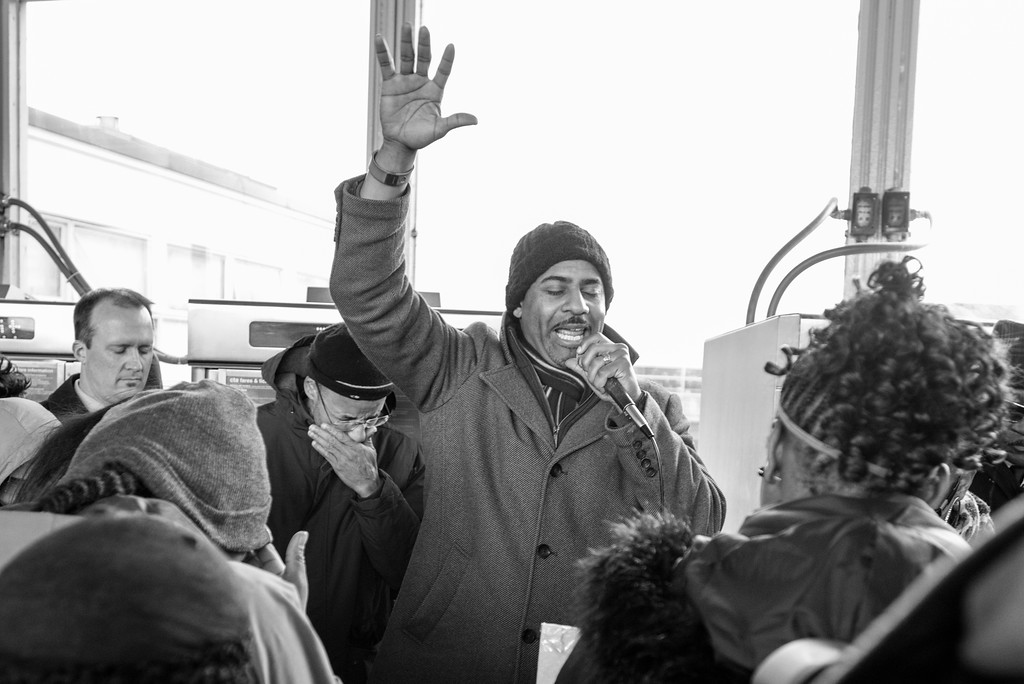
Mass Incarceration. The New Jim Crow. The War on Drugs. Thanks to Professor Michelle Alexander these phrases are now intimately linked in the minds of social justice advocates and faith leaders as we begin a critical struggle for fairness, justice and human rights in the criminal courts, police precincts and prisons of America. The Next Movement is convinced that America can do better, and that the majority of Americans would want us to do better, if they knew the truth. The truth about systemic incarceration, structural second class status, completely uneven law enforcement practices, oppressive and selectively enforced laws that is filling the prisons of America.

Wednesday, February 15, 2017

Only YOU Can Prevent the Coming Police State...

Family,


Over the past few years we have witnessed police abuse of power on a visceral level unknown throughout our history. The almost universality of the camera phone, the increased use of police dashboard cameras, and the early implementation of police body cameras, have brought the public right into the midst of police/public interaction.

The murder of Laquan McDonald, shot 16 times by a Chicago Police officer, and the attempted cover up, caused the resignation of Gerry McCarthy, the police chief of one of the largest departments in the country. And soon after, the defeat of powerful Cook County States Attorney, Anita Alvarez. Many suspect that Mayor Rahm Emanuel will also be unable to wipe the blood of Mr. McDonald off in time to save his next election bid.

Lest we sleep, police unions, and "law and order" politicians are, of course, fighting back. Oh, that they would be fighting back with better oversight, removal of criminal police officers from their rolls, renewed programs to build relationships with the communities they serve, or an end to racial profiling and "stop-and-frisk" citizen stops. What a blessing this would be!

But no, instead, they are digging in, as an occupying force would be expected to do.

One of the local efforts has been the so-called Blue Lives Matter ordinance, led by Alderman Ed Burke. Essentially, this is an example of overkill, and as University of Chicago Law Professor, Geoffrey Stony said, ". . . why do we need this new law? Other than the symbolic dumping on Black Lives Matter, which is ugly." #BlackLivesMatter and many other millennial infused justice organizations have proven effective in fighting for basic human rights in America, and as such are being targeted by our increasingly racist government administrations - it will only get worse.

Nationally, there are at least 10 states that are working to criminalize protests. For example:

  • In North Dakota, where the DAPL protests have been taking place, they have introduced a bill, HB 1203, which provides for a legal exemption to motorists that "negligently [cause] injury or death to an individual obstructing vehicular traffic on a public road…” 
  • In Indiana, SB 285 provides law enforcement to “use any means necessary to clear the roads of the persons unlawfully obstructing vehicular traffic” once a gathering is determined to be unlawful.
  • In Michigan, a bill was passed that provides for fines of $1,000 a day for individuals and $10,000 a day for organizations for picketing.
These actual, and prospective, laws are designed to limit our right to protest, to silence the people. 


And now comes an executive order from #45 . . .

Instead of focusing his efforts on the causes of violence in our communities, this order calls on the Department of Justice (now led by ex-senator Jeff Sessions, a man viewed as too racist to serve as a judge) to work with other federal agencies (FBI, NSA, Homeland Security, etc.) to "develop an executive branch strategy to prevent violence against Federal, State, tribal, and local law enforcement officers." 

From our local politicians to state politicians across the country, to president #45, there is a concerted effort to stifle free speech and our right to assemble in defense of our rights and the constitution. 

We must stay vigilant! We must stay engaged! We must stay woke!


Over the coming days, weeks and months you will hear of protests, petitions, boycotts, letter writing campaigns, etc. Don't leave it up to your neighbor to respond!

A luta continua,


Daryle Brown
Trinity UCC Justice Watch Team
The Next Movement committee

P.S. Thank you to the elected Community Police Accountability Council for continually sharing content relevant to the fight, much of it used in developing this note.

Thursday, April 30, 2015

Action Taken on Excessive Police Powers


Hmm, went to post a new blog today and discovered that this one was never published! Still, good thing that Eric Holder did. Now let's see what the new AG has in store for us . . .

From Jan 16th . . .

Few people realize that police departments across this country can confiscate property - homes, cars, cash - without a criminal conviction, plea bargain, or even evidence of a crime.

That's right! You could be driving from your home with cash collected to put a down payment on a home, and the police can stop you, search your car (if you give permission, which most people are afraid not to . . . even though it is YOUR RIGHT), and if they found your $5,000 in an envelope, could assume it was from criminal activity and confiscate it.

"Innocent until proven guilty" means nothing in these situations. It is your responsibility to prove to the police that your property was in your possession legally.

On Friday, January 16, 2014, Attorney General Eric Holder issued an order barring local and state police from using federal law to confiscate property without proving that a crime occurred (see entire article by clicking here).

Since 2008 state and local police departments have confiscated cash and property worth over $3 billion (THREE BILLION DOLLARS), in more than 55,000 seizures. 

The federal program, called Equitable Sharing, allowed the local agencies to keep 80% of the proceeds, and balance going to federal agencies.

As we work to end mass incarceration in America, this type of program that provides incentives for police to behave inappropriately must be closed down!

This was a great decision by A.G. Holder and a victory to be celebrated.

A luta continua,

Daryle

Wednesday, December 3, 2014

It is Darkest Before the Dawn . . .

Family,

For me, the Ferguson grand jury decision not to charge police officer Darren Wilson with a crime in the shooting of Michael Brown, was not a surprise. I may have been surprised at the ineptitude of the prosecutor, or the clumsy way they announced it, or the attempt to explain away the racist overtones, but I never expected justice.

The killing of Eric Garner was different. Here there was a video of the police choking this man to death . . . of Mr. Garner repeating over and over, "I can't breath." (CAUTION, the video is painful to view. You can view by clicking here.) How in the world can a grand jury not even think the case deserved to go to trial? 

Well, in the midst of my revulsion, as I'm distracted and less productive than I should be, Asha Bandele (Director, Advocacy Grants Program at the Drug Policy Alliance (DPA)) sends out a note to the many partners of DPA regarding the decision. She has graciously allowed me to reprint it here:

Dearest Partners,

In May of 1857, having just heard of the Supreme Court’s decision in the Dred Scott case (for those of us thinking of Travyon Martin today, ironically it was filed as Dred Scott v Sandford), which in effect validated the existence of slavery and seemed to ensure its continuance, the great abolitionist, orator and ex-slave, Frederick Douglass, said: 
In one view the slaveholders have a decided advantage over all opposition. It is well to notice this advantage…(but)  This is one view….there is another, and a brighter view. David, you know, looked small and insignificant when going to meet Goliath, but looked larger when he had slain his foe….Thus hath it ever been. Oppression, organized as ours is, will appear invincible up to the very hour of its fall….Take this fact—for it is a fact—the anti-slavery movement has, from first to last, suffered no abatement. It has gone forth in all directions, and is now felt in the remotest extremities of the Republic. 
It started small, and was without capital either in men or money. The odds were all against it. It literally had nothing to lose, and everything to gain. There was ignorance to be enlightened, error to be combatted, conscience to be awakened, prejudice to be overcome, apathy to be aroused, the right of speech to be secured, mob violence to be subdued, and a deep, radical change to be inwrought in the mind and heart of the whole nation. This great work, under God, has gone on, and gone on gloriously…Our strength is in the growth of [our] conviction, and this has never halted. 
In less than six years after he made that statement, of course, the Emancipation Proclamation was signed.

And so as the progeny of people who traversed mountains higher and more rocky than ours, and with far fewer resources, we continue.  And we do it with all the care, compassion and strategic brilliance that has defined us every day leading up to this day.  We do it as allies, we do it as colleagues, we do it as organizers and friends.  We do it as partners in this work.

The horrific decisions out of Ferguson and now, New York, have this moment. We acknowledge that. But knitting ourselves together I know this: we will write the final and beautiful chapter in history.

With a powerful belief in justice and in each of you,

asha

We will indeed write the final AND beautiful chapter in history. The fight to end mass incarceration in America, to end this War on Drugs that is stripping resources from our education systems, our health care systems, our infrastructure (spelled JOBS), will be won! Because this is where justice resides. Every injustice like in Ferguson, or in New York, feeds fresh warriors into our campaigns.

For now, let's keep Galatians 6:9 in our thoughts:

"Let us not become weary in doing good, for at the proper time we will reap a harvest if we do not give up."     
 A luta Continua,

Daryle

Sunday, November 9, 2014

Harry Belafonte: The Power of Film

Harry Belafonte and Sidney Portier at the Governors Awards
Harry Belafonte was the recipient of the Jean Hersholt Humanitarian Award at the Governors Awards (an honorary Oscar, Mr. Belafonte's first).

His acceptance speech was incredibly powerful, insightful, incriminating, and at the same time hopeful.

What a wonderful brother, artist, and of course humanitarian.

The power of film to change minds and hearts was never so eloquently stated. This is the reason that The Next Movement embarked on our (In))Justice for All Film Festival this year, and are committed to screen meaningful social justice focused films on a regular basis, and to hold our festival annually. The 2015 festival will be held April 9-18.


You can view this wonderful acceptance speech by CLICKING HERE. Truly one of the giants of both entertainment and justice. An awesome example for us all.

Daryle Brown


Wednesday, October 22, 2014

From the Inside: Dre's Story

He’s from a small northern suburb that doesn’t set off alarms in your head, like when you hear
“Englewood.”  It is home to the illustrious campus of Northwestern University, choice lake front real estate and one of the largest high schools in the country… even in the high crime areas, you can step out your front door in the morning and smell the life vibrating beneath the heavy mist of dew that has settled on the grass and trees. Dre trampled over this pulsating scenery like it was the desolate wild west.  Because when he’s gone off the weed and alcohol, he thinks he’s an outlaw.
 
When Dre was four, he was walking down an alley with his seventeen year old uncle, Ty, when gun shots rang out nearby.  “Stay here, Andre,” his uncle told him while pushing him between two garbage cans. 
 
“Don’t move until I come back!”
 
Ty pulled a gun from his waist and disappeared between two buildings. He was caught in a gang-related murder and Dre wouldn’t see him again until twelve years later.
 
It would be like he never left though, because Dre would be confronted by his uncle’s reputation all through his childhood. He would constantly hear from family and people in the neighborhood about his uncle’s phenomenal attributes. 
 
“He was so charismatic, all the ladies loved him.”… “He was so tough, all the guys respected him.”
 
Dre had none of these traits. As he got older and people found out he was Ty’s nephew, you couldn’t help but notice the shadow of disappointment move across their faces.
 
Dre was the shy, timid, soft-spoken type. 
 
“Speak up boy!” His dad would snap at him.  “You talk like you got rocks in your throat!” 
 
Dre’s over-protective parents kept him isolated in the house most of the time, which made him socially awkward, but an avid reader. By the time he got to high school, he had already read the majority of the books on the English curriculum. They had to place him in honors class.
 
Despite his academic potential, Dre wanted nothing more than to shake this lame persona. The characters he looked to emulate were the cats, like Uncle Ty: the dudes standing across the street from the school with their hats broke off; proudly throwing their hands in the air with fingers twisted up in signs to their allies; and embracing each other with secret handshakes. A brotherhood.  Everyone seemed to either love or fear them.
 
It was really this fear that kept him in check. But, when he was fifteen, he discovered a magic potion that would suppress that fear: weed and alcohol. He initially tried them when offered, because he didn’t want to be the square that said, “No.”
 
But, it was the effects that kept him coming back. The weed, by itself, was fun;  but, it made him feel more nervous and more vulnerable than when he wasn’t high. The liquor was another story. He felt like he had been dipped in a vat of radioactive waste and emerged a superhero. He didn’t feel like the same timid, insecure, cowardly guy he was before. Instead, he felt bold, confident, fearless; he felt free.
 
Dre stumbled through the rest of high school in a drunken haze, and just barely graduated. The weed and alcohol took him down a dark road. Under the influence, he chose to be initiated into the “brotherhood.” He so much admired them that, while under the influence, he chose to pick up a gun and shoot at someone he had been convinced was his enemy. 
 
When he woke up sober the next morning, his stomach dropped, as he remembered the things he had done. But, it was too late to think. He was nineteen years old, sitting in the county jail, facing attempted murder charges.
 
While he was on the inside, the thirst only grew. From what he could see around him, drugs and alcohol was the culture. Everyone did something. Even if they didn’t, he wore his addiction like a badge of honor. It was his identity. The only way he knew how to be. There was no reason to believe he had a problem, so despite the Narcotics Anonymous and Alcohol Anonymous programs that were offered on the inside, Dre looked at them as irrelevant to him. He eagerly awaited his parole date and that first drink…
 
Dre is now thirty-four, and serving a sixty-year sentence. He learned that putting on a mask doesn’t change who you are.

Monday, May 26, 2014

Evidence is one thing, Fighting is the right thing

A good friend and mentor, Howard Saffold (a founder of the Negro Patrolman's League and CEO of the Positive Anti-Crime Trust), once forwarded to me a wonderful report, The Adoration of the Question: Reflections on the Failure to Reduce Racial & Ethnic Disparities in the Juvenile Justice System. The actual report deals with challenges to move from theory to action, from minor tinkering to real transformation, in the obvious and clearly unjust racial and ethnic disparities in our juvenile justice system, but the first part of the title, "The Adoration of the Question," has stuck with me through the years as the reams of studies have been developed on the issue of mass incarceration, but the will of our politicians, and our people, seems unmotivated to act.

This editorial in the NYTimes is another high profile call for an end to America's epidemic of mass incarceration. Motivated by a 444 page report from the National Academy of Sciences, The Growth of Incarceration in the United States: Exploring Causes and Consequences - yet another treatise on this issue - they quote the usual statistics (2.2 million incarcerated Americans, disproportional effects on black, brown and poor, nearly 160,000 people serving life sentences) and some new ones ($80 billion a year spent on direct corrections costs). They also mention a report by Human Rights Watch, Nation Behind Bars: A Human Rights Solution, and a particular quote:

. . . while prison should generally be a last resort, in the United States “it has been treated as the medicine that cures all ills,” and that “in its embrace of incarceration, the country seems to have forgotten just how severe a punishment it is.”
With Professor Angela Davis' book, Are Prisons Obsolete?, from 2002, and Professor Michelle Alexander's more recent book, The New Jim Crow: Mass Incarceration in the Age of Color Blindness, and the many other books, research reports, editorials, documentary films, etc., that describe and inform on the subject of prison and mass incarceration, the depth and damage of this humanitarian nightmare is clear.

What is needed now is not more Adoration of the Question, but more action!

There are organizations spouting up in cities across America focused on ending the mass incarceration epidemic, ending the drug war, making sense of our sentencing laws, and reestablishing mental health treatment capacity in this country.  If you are in Chicago, join us, The Next Movement. If you are anywhere else in the country, look for a Campaign to End The New Jim Crow, or contact us to help locate an organization in your area.

Stop adoring and start fighting.

A luta continua,

Daryle Brown


Sunday, May 18, 2014

Modern Day Torture Chambers

Even though I have been visiting prisons in Cook County, throughout the State of Illinois, and even Oxford Federal Prison in Wisconsin, for many years, the revelation of excessively poor treatment coming out of Menard Prison was shocking.

The preliminary report from Alan Mills, the Legal Director of The Law Center, is an indictment on our very humanity. Our government would close down a puppy breeder for less negligent behavior. Our prison officials, and elected representatives by extension, are so callous, cruel and indifferent to incarcerated citizens, leaving them to be subject to disease and suffering that is totally unnecessary. When these men return to their community, what will be left of their humanity!

Please check out this article by clicking here.

As your anger rises, as your empathy kicks in, consider joining with your Prison Ministry or The Next Movement committee (of the Prison Ministry) to fight for justice, for humane treatment of prisoners, for an end to America's love affair with incarceration.

Daryle Brown

Wednesday, May 7, 2014

Free Entrepreneurship Program Exclusively for Ex-Offenders

Sent to us by friend of the cause, Prof. Randolph Stone:


Free Entrepreneurship Program
Exclusively for Ex-Offenders

Starts June 9, 2014
Greetings! 

Greetings from the IL-SBDC/Duman Entrepreneurship Center at JVS Chicago. We are pleased to announce that the Basic Entrepreneurship Support and Training Program (B.E.S.T.) is accepting participants for its first session of 2014. B.E.S.T. is a six week course of entrepreneurial training exclusively for ex-offenders. The next session will start on June 9th, 2014.

In 2013, sixty seven (67) ex-offenders completed the B.E.S.T. Program achieving nine new business starts or expansions and 14 new jobs were created. In addition, five of these businesses were funded through our B.E.S.T. micro-loan program, which is earmarked exclusively for ex-offenders. We are looking to create many new success stories for 2014.

We are reaching out to all of our partners to assist us in identifying qualified individuals who would benefit from this program. Thank you for your continuing support of this program.

The Duman Entrepreneurship Center Team

We need 30 Ex-Offenders
looking to start or expand a small business
and to become one of our many success stories.
There have been many successful
business start-ups and expansions
since the inception of the program.


Upon successful completion of this course, participants will be able to:

  • Plan for the start-up or expansion of a successful small business
  • Create and write a successful business plan
  • Design an industry specific marketing plan
  • Address financial planning and credit issues
  • Understand business structure and risk management
  • Examine options for funding a small business
  • Apply for funding through the B.E.S.T. Loan Program 

Microloans are Available!
Eligible program participants can receive microloans up to $5,000 to start or expand their business.

May be the last opportunity to participate in this program for 2014. Classes fill fast!
  
Important Information and Registration
Registration and Additional Information
All classes will be held at:

JVS Chicago
216 W. Jackson, 2nd Floor
Chicago, IL 60606
  
To register, and for more information, contact:
JVS Chicago
Duman Microenterprise Center
855-INFO-JVS
(855-463-6587)
  
  
Register Today
Space is Limited!
  
City of Chicago Residency Required
This program is funded by the City of Chicago
Department of Family and Support Services

Monday, February 10, 2014

From the Inside: Chris' Story


Previously we  we introduced Andre "Dre" Patterson, a resident in Stateville Correctional Center, and a volunteer writer for The Next Movement's blog. His first series of articles will be focusing on various crossroads . . . intersection points where a better decision could have led to an entirely different future. This is the third installment . . .

Chris' Story

The middle-class suburb of Mundelein (where the employment rate is high, and violent crimes were minimal to non-existent) has a greasy underbelly.  This mostly White and Hispanic town is home to an affluent drug culture.  The notorious Mexican Mafia has a strong hold on the cocaine trade, and kids can get ahold of any drug on the spectrum; from prescription pills to acid.  With such easy access, you can become an addict, a dealer, or both early on--the user and the used.

This was the breeding ground for Chris; a lanky, pale-skinned, anti-social kid, with natural leadership skills.  He stayed in a one story, five-bedroom house with his mother, younger sister and older brother, who was in and out of jail.  His brother was deeply entrenched in Mundelein’s drug scene, a user and one of the used.  This is where Chris took his example from; with a father in Tennessee, and mother that worked days and went to school at night, he was left to figure things out on his own. 

He was also left to deal with the memory of something horrible he had done when he was ten.  “It jarred me awake every morning, like the annoying beep of an alarm clock.  The same nightmare from something that I did when I was too young to know better.  At least that’s what family told me.  But I had a different narrative of the events.  What I did, chased my conscience, so I chased it away with vodka and cocaine.” 

When he was eleven, Chris started down a dark road that he mistook for an escape route, when he began smoking marijuana.  At thirteen, he added alcohol to an everyday weed habit.  He began a rapid plunge to the bottom when at fourteen, he was introduced to cocaine.  This would be the ultimate escape from his conscience that he was looking for.

At fifteen, Chris checked into a thirty-day rehab to avoid jail time for a series of under-age drinking and possession arrests.  While in the facility, he had a brief moment of clarity and attempted to get clean.  But the moment passed when he couldn’t envision the future sober.  Chris continued to get high in rehab.

Throughout all of this, Chris tried to stay in school, while residing in his chemically altered universe.  But, in his fourth year of high school, totally disengaged with education, he dropped out.  Around this time, Chris and some friends started burglarizing known drug houses. 

Usually, nobody was home.  But one day, someone surprised Chris and his crew and things got out of hand.  Chris was only eighteen when he came to jail charged with a home invasion & murder.

Tuesday, December 3, 2013

SB 1342 - A Small Victory . . . But the Fight Must Continue

Family,

Thanks to the hard work of many organizations and individuals we have won a small victory, as SB1342 will not be introduced during the winter veto session. The political forces behind this inhumane legislation have retreated back into their smoke filled rooms to negotiate with, pressure and cajole our legislators into some future form of a bill next year.

Our job is to continue to reach out to our state representatives and senators and urge them to
vote against whatever future form SB 1342 takes.

Until every human (that means you) is mistake-proof, mandatory minimum sentencing makes no sense.

Consider this: In a roomful of teen-aged boys, who may or may not have been listening, he carried himself with such dignity and self-control that he seemed like a king. Since I don’t remember his name, let’s just call him King.

He’d come to share his experience in hopes that they would learn from it. In his sixty years he’d had many experiences. He was a Vietnam veteran who served his country and returned home to diligently work and provide for his family until his recent retirement. And now he was a convicted felon, serving eighteen months in prison.

His crime? While driving his car, King made a left hand turn without signaling. After being stopped by the police, he agreed to let them search his car. Why not? He’d never broken the law and wasn’t breaking one now. Why not cooperate with their request? He had nothing to hide. Unless you count that unregistered gun his brother had left in the car without King’s knowledge.

In Illinois an unregistered gun in a car owned and driven by King was considered HIS gun. The prosecutor decided to pursue the case. In the U.S. criminal justice system, the prosecuting attorney has the power to choose which cases to pursue - almost absolute power. The only thing that comes close to offsetting that power is the discretion left to judges in the sentences they give.

King received eighteen months in prison for his “crime.” He could have received more. He possibly could have received less. Personally, I don’t think he should have gone to prison at all. But still, the judge made the choice to give less time than what he could have received. The judge made the choice. Let me repeat, the JUDGE made the choice.

In the legislation proposed by SB 1342, judges will have absolutely no choice in the sentences given for illegal gun possession. First-time offenders would receive a mandatory three-year sentence, regardless of the circumstances. Judges would have no choice.

Mandatory sentencing has been shown to be ineffective in deterring crime. It has been proven to result in a disproportionate number of people of color being incarcerated. You may believe the hype that mandatory sentencing is necessary to stop gun violence. You may choose to support the next version of SB 1342, or to fail to voice your opinion at all.

Just remember your choice the next time you forget to use your turn signal.

To continue the fight against mandatory minimum sentences for gun crimes:

  • Please keep calling, emailing, writing to your elected officials and get others to do the same. Find out how by clicking here
  • Grow your personal knowledge of the issue using the resources below:
  • The bill's sponsor, Rep. Mike Zalewski’s, editorial about SB 1342 has had highlights included (click on them to see the comments) to show some of the key areas of disagreement. Click here to view and of course, feel free to share with others. 
  • Lastly, this click here for an excellent brief from the Shriver Center on the effectiveness of mandatory minimums. 
The fight is not yet won. We must remain diligent. Thank you all for your help in defeating this bad legislation thus far, and keep up the good work!

Michelle Day, Esq.
The Next Movement, Project Nehemiah &
Trinity UCC Justice Watch Team

Tuesday, November 19, 2013

From The Inside: Worm's Story

Last week we introduced Andre "Dre" Patterson, a resident in Stateville Correctional Center, and a volunteer writer for The Next Movement's blog. The first series of articles will be focusing on various crossroads . . . intersection points where a better decision could have led to an entirely different future. Here's . . .

Worm's Story

Nobody told him he wasn’t supposed to. That was the mindset of twelve year old Willie or “Worm”, the first time he got high. Even if someone had told him “just say no,” it probably would have gone over the cornrows on his head atop his four foot tall body. Raised in the land of vacant lots and dope spots, which is the west side of Chicago; Worm’s natural reaction was to do as he saw, not as he was told.


When Worm was eight, his mother and uncles used to throw raucous card parties with all of the neighborhood super-heroes: gangsters and hustlers. They would send little Worm back and forth to the store and have him light their squares (cigarettes) and joints. So, when he was twelve and one of his friends passed him a blunt and told him to light it, Worm did so like he had been there before.

During these same social gatherings, his mom would give him beer and put Worm in a circle of family and friends to sing and dance. Times like these inspired Worm to want to be a rapper and comedian.  He associated the weed and alcohol with fun and celebration. By the time Worm was fifteen, he was smoking and drinking every day.

With a father who lived in the suburbs, who he only saw when he got in trouble, Worm bonded with his step-dad; a small business owner and a well-known drug dealer.  His step-dad gave him a small amount of drugs to sell so Worm could buy clothes and maintain his habits. Having been inducted into street culture by his uncles when he was big enough to sit on a watermelon and break it, this was a natural transition for Worm.

In an attempt to pull her son from the tumultuous waters he had dived into, Worm’s mom sent him away to boot camp, where she hoped he would finish his education and learn discipline. It was just a vacation for Worm. When he completed the program, Worm came back home to the same poverty and hopelessness he had left. The weed he smoked to see the silver lining of the gray cloud over his environment would evolve into something more severe.

One day, a hail of gunfire parted a crowd that Worm was congregated in, causing them to duck in panic, behind parked cars and porch steps. When the shots let up, two of Worm’s closest friends lay on the unforgiving concrete, bleeding to death. That night, an angry and saddened Worm tried a drug that he had been shielded from up to this point. One of his homies, also grieving from the day’s mad drama, lit up a blunt laced with PCP, called shock. “Let me hit that shock,” a dejected Worm demanded. That first hit would consummate a long relationship between Worm and shock, that would only end when he was charged with first-degree murder, five years later.

Monday, November 11, 2013

From The Inside: Introducing Andre "Dre" Patterson

Friends,

As we work to end the epidemic of mass incarceration in America one of our
challenges to to present the human side of this travesty. This can often be seen in the broken families, the struggling children, the collective misery of the communities from which men, women and children are drawn into our criminal (in)justice system.

Of course these are not all angels of misfortune. Of course human choice, personal decisions, often play a major role in determining who will populate the jails and prisons of America. And yes, of course, a stacked deck works to funnel many promising lives into permanent second class citizenship, if they are luck, or if not, a near permanent residence in one of our prisons.

Several months ago, one of our members, Ibi Cole, introduced me to a young man that resides in Stateville, a maximum security prison on the outskirts of Chicagoland. Andre is one of those promising lives that has taken up permanent residence in our prisons. Intelligent, articulate, and a gifted writer, he wanted to know if he could contribute to our fight against mass incarceration . . . even from behind bars.

Our conversations, passed through communications that Ibi facilitated, have resulted in this first series of blogs From the Inside. I've asked Andre to talk with/interview the men he shares Stateville with, focusing particularly on the "forks in the road" that led to their imprisonment. I am prayerful that each story/article will move someone's heart as we recognize our own friends, family and ourselves: But for the grace of God go I . . .

Our goal is to share a new story every other week or so for the next several months, with the first story beginning November 18th. 

Lastly, please take a few moments to provide feedback on the stories. You can comment on the blog itself, or on the various Facebook pages that we will be linking to. That said, let me introduce you to Andre:

A luta continua

Daryle Brown


My name is Andre Patterson, known to loved ones as, simply, “Dre.” I graduated from Evanston Township High School in 1997; I was an average student, with above average potential.  The northern suburbs of Evanston are not the most dangerous or degraded environments to grow up in.  But, viewing the mostly green landscape from the shadows of insecurity, personal pain and alcoholism, it appeared dark and decrepit.
Lacking the courage and tools to conquer my demons, I made some bad decisions, that lead to a sixty-year sentence in the Illinois Department of Corrections.  My cowardice has broken many lives, some of which I may never be able to piece together again.  But I would like to try… 
I’m going to tell you stories of other men, incarcerated like me, whose demons have manifested through addiction.  Maybe their lives and the lives they’ve affected through their actions could have turned out differently… if these addictions were viewed in a different light.

Dre

Thursday, October 3, 2013

Will Cold Facts Warm Hearts? New Reports Should Call Us to Action

Today, The Sentencing Project, an organization dedicated to researching, generating publications, and advocacy, in order to change America's thinking about crime and punishment, released two significant reports. Both are intended as shadow reports to the United Nations Human Rights Committee and were written in advance of its review of U.S. compliance with the International Covenant on Civil and Political Rights (ICCPR) later this month.

The first, Racial Disparities in the United States Criminal Justice System, delivers the data to show what most of us already know - that the justice system in America imprisons vast numbers of our citizens, far more than any other country in the world, and that there are incredible racial disparities.

FACTS:
  • Black men are 6 times more likely to be incarcerated than white males
  • Black men are 2.5 times more likely to be incarcerated than Hispanic males
  • If current trends continue, one in every three black American men born today can expect to go to prison in his lifetime. ONE IN THREE! This is true for one in six Latino males and only one in seventeen white males.

Their findings lead them to conclude:
By creating and perpetuating policies that allow such racial disparities to exist in its criminal justice system, the United States is in violation of its obligations under Articles 2 and 26 of the International Covenant on Civil and Political Rights to ensure that all its citizens—regardless of race—are treated equally under the law. 
Essentially, our criminal justice system is deeply flawed and this report is a solid piece that provides evidence of those flaws at every level - from police activity, to trials that have well-equipped and motivated prosecutors against overworked indigent defense counsel, and the failure of our system of "presumed innocence" and ultimately, huge disparities in sentencing, once convicted, including the use of capital punishment.

The second report, Democracy Imprisoned: A Review of the Prevalence and Impact of Felony Disenfranchisement Laws in the United States, provides insight into, as Professor Michelle Alexander, author of The New Jim Crow: Mass Incarceration in the Age of Colorblindness, explains it, a new caste system that has developed in America - the formerly incarcerated.

FACTS:
  • Despite decreases in overall prison populations in the last three years, the number of disenfranchised citizens has continued to grow, with over 5.85 million in 2010 (compared to 1.17 million in 1976).
  • 75% of these disenfranchised individuals reside in their communities
  • 7.7% of adult African Americans are disenfranchised, more than 40% of whom have completed their sentences

As with the first report, these findings show America to be in violation with the U.N. Covenant on Civil and Political Rights, specifically:
“general deprivation of the right to vote for persons who have received a felony conviction, and in particular for those who are no longer deprived of liberty, do not meet the requirements of articles 25 and 26 of the Covenant, nor serves the rehabilitation goals of article 10(3)."
While they detail the grievances associated with voting rights, there are a litany of other handicaps heaped on the formerly incarcerated, including federal housing, student loans, food assistance, and various job licensing restrictions.


Unfortunately, These Facts Are Not New 

All of this has been adequately documented by Professor Alexander among others, and in fact The Next Movement, through various methods, has been working to educate the community and grow awareness.

But where is the community uprising, the indignation, the mass outrage, the ACTION?

It is easy to feel overwhelmed by the issues of our time and to let that feeling of hopelessness "move" us to inaction. Fortunately, the evidence of our victory has already been witnessed by how far we have come.  As I was seeking to be accurate with Dr. King's quote on the "arch of the moral universe," I came across what is purported to be the first documented use of this metaphor, from Rev. Theodore Parker, an abolitionist who in an 1857 collection of sermons included this language in his message, Of Justice and the Conscience:
"Look at the facts of the world. You see a continual and progressive triumph of the right. I do not pretend to understand the moral universe, the arc is a long one, my eye reaches but little ways. I cannot calculate the curve and complete the figure by the experience of sight; I can divine it by conscience. But from what I see I am sure it bends towards justice."
Clearly there are incredible injustices at work in the criminal justice system in America. Certainly, as people of conscience and people of faith, we know that something must be done. The Next Movement is one organization that is working to end this era of mass incarceration, and can use all the help, ideas, and energy, we can get. Join us! Email us at  TheNextMovement@trinitychicago.org for more information.

Rev. Courtney Jenkins, in a sermon delivered here at Trinity UCC, taught that (paraphrasing), "Our God wants to show off His power. In our prayers, we need to ask for great things, awesome things, change that can only come about by the intercession of God power." Ending the mass incarceration epidemic in America is worthy of our prayers and will prove to be an incredible example of God's power.

2 Corinthians 9:8-10, NRSV translation, states:
8And God is able to provide you with every blessing in abundance, so that by always having enough of everything, you may share abundantly in every good work.  9As it is written,
“He scatters abroad, he gives to the poor, his righteousness endures forever.”
10He who supplies seed to the sower and bread for food will supply and multiply your seed for sowing and increase the harvest of your righteousness.
God bless you.

A luta continua

Daryle Brown